
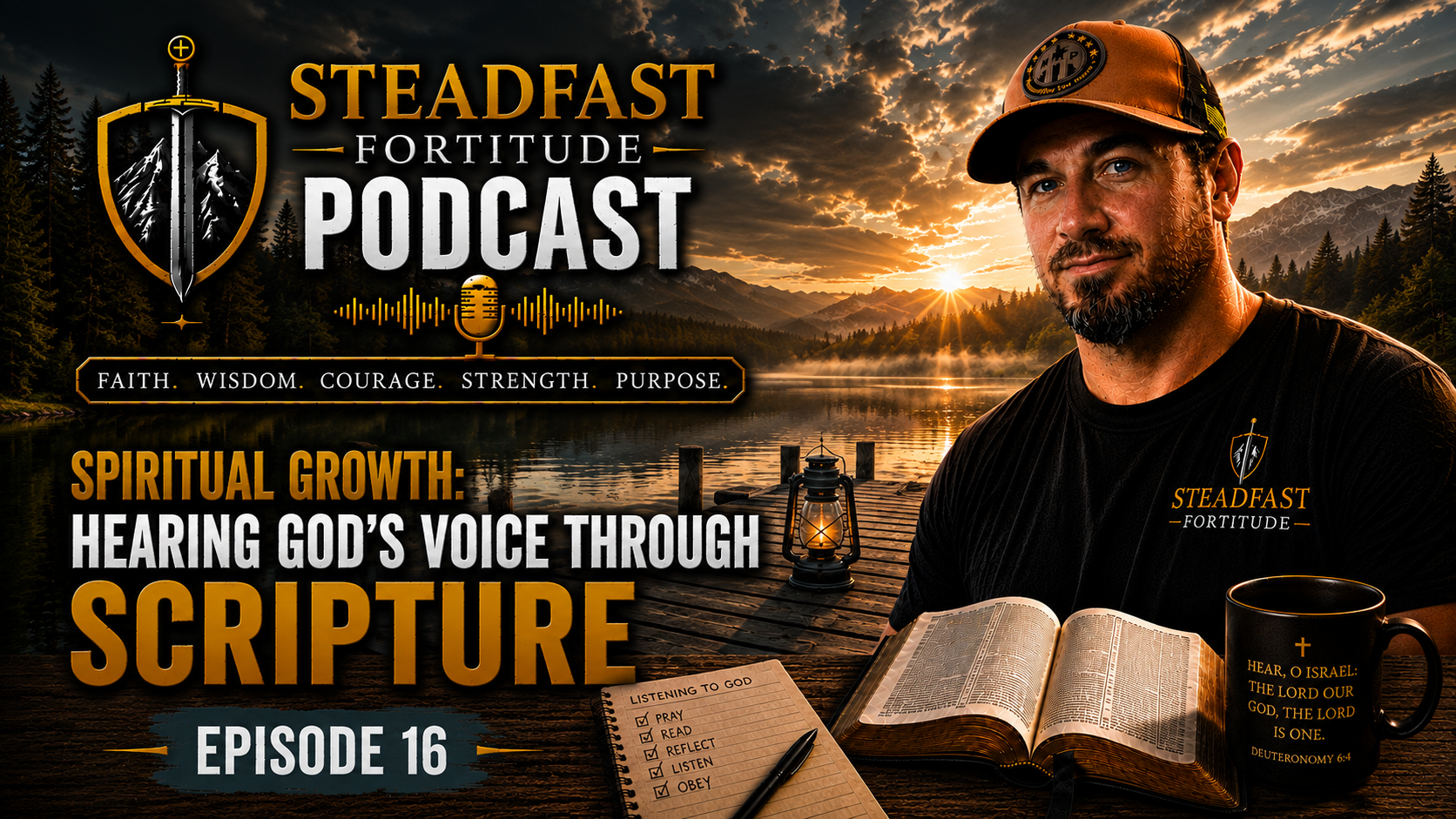
Episode 16: Spiritual Growth – Hearing God’s Voice Through Scripture
Episode Overview
How do we hear God’s voice and understand His direction for our lives? Episode 16 explores one of the primary ways God has chosen to speak to His people—through His written Word. This episode looks at why Scripture can be trusted as God’s inspired truth, how the Holy Spirit helps us understand and apply it, the importance of reading the Bible consistently and in context, and how knowing God’s Word helps us recognize His character and make decisions that align with His will.
Listen above, share this episode with someone who may need to hear its message, and follow the Steadfast Fortitude Podcast on your favorite podcast platform so you don’t miss future episodes.
Episode Context
Many Christians have experienced moments when they wished God would simply tell them exactly what to do. We may be facing an important decision, walking through uncertainty, or sincerely seeking God’s will and wondering, “How can I hear God’s voice?”
In searching for an answer, it can be tempting to wait for a dramatic sign, extraordinary experience, or unmistakable message while overlooking something God has already provided: His Word.
Second Timothy 3:16–17 tells us, “All Scripture is God-breathed and is useful for teaching, rebuking, correcting and training in righteousness.” (NIV)
The Bible isn’t merely a collection of ancient writings, inspirational stories, or human wisdom. Scripture is God’s inspired Word. Through it, God reveals His character, His truth, His commands, His promises, and His plan of redemption through Jesus Christ.
That means Bible reading should involve more than asking how many chapters we can complete. A better question may be, “What is God teaching me through His Word today?”
Hebrews 4:12 describes God’s Word as “alive and active.” (NIV) Scripture’s meaning doesn’t change according to our circumstances, but God’s unchanging truth continually speaks into changing seasons of life. A familiar passage may encourage us during one season, convict us during another, and strengthen us years later as we encounter circumstances we hadn’t previously experienced.
Learning to recognize God’s truth begins with consistently spending time in Scripture. Just as familiarity helps us recognize someone’s voice, becoming familiar with God’s Word helps us better understand His character and ways.
We should also read prayerfully. Psalm 119:18 says, “Open my eyes that I may see wonderful things in your law.” (NIV) We need more than information—we need understanding. The Holy Spirit helps illuminate Scripture and enables us to recognize how God’s truth should shape our lives.
Context is equally important. The Bible isn’t a collection of disconnected verses intended to provide personalized messages when randomly selected. Each passage exists within a chapter, book, historical setting, and the larger biblical story. Understanding that context protects us from assigning meanings to Scripture that God never intended.
This gives us another important principle for discernment: God will never lead us contrary to His revealed Word.
Feelings can be powerful, but they aren’t always reliable. If something we believe God is leading us toward clearly contradicts Scripture, then that direction isn’t from Him. God’s character and truth remain consistent.
The more Scripture shapes our thinking, the more our questions begin to change. Instead of only asking, “What do I want to do?” or even “What should I do?” we begin asking, “What choice most faithfully reflects God’s character and His Word?”
Jesus demonstrated this dependence upon Scripture during His temptation in the wilderness. Again and again, He responded with the truth of what was written. God’s Word provided the foundation for His response.
Hearing God’s truth also requires willingness to obey it. Scripture isn’t intended merely to inform us—it is meant to transform us.
As you reflect on this episode, consider these three questions the next time you open your Bible:
What does this passage teach me about God? What does it reveal about how I should live? What step of obedience can I take because of what I’ve read?
Stay rooted in God’s Word. Stand firm in your faith. Live with steadfast fortitude.