
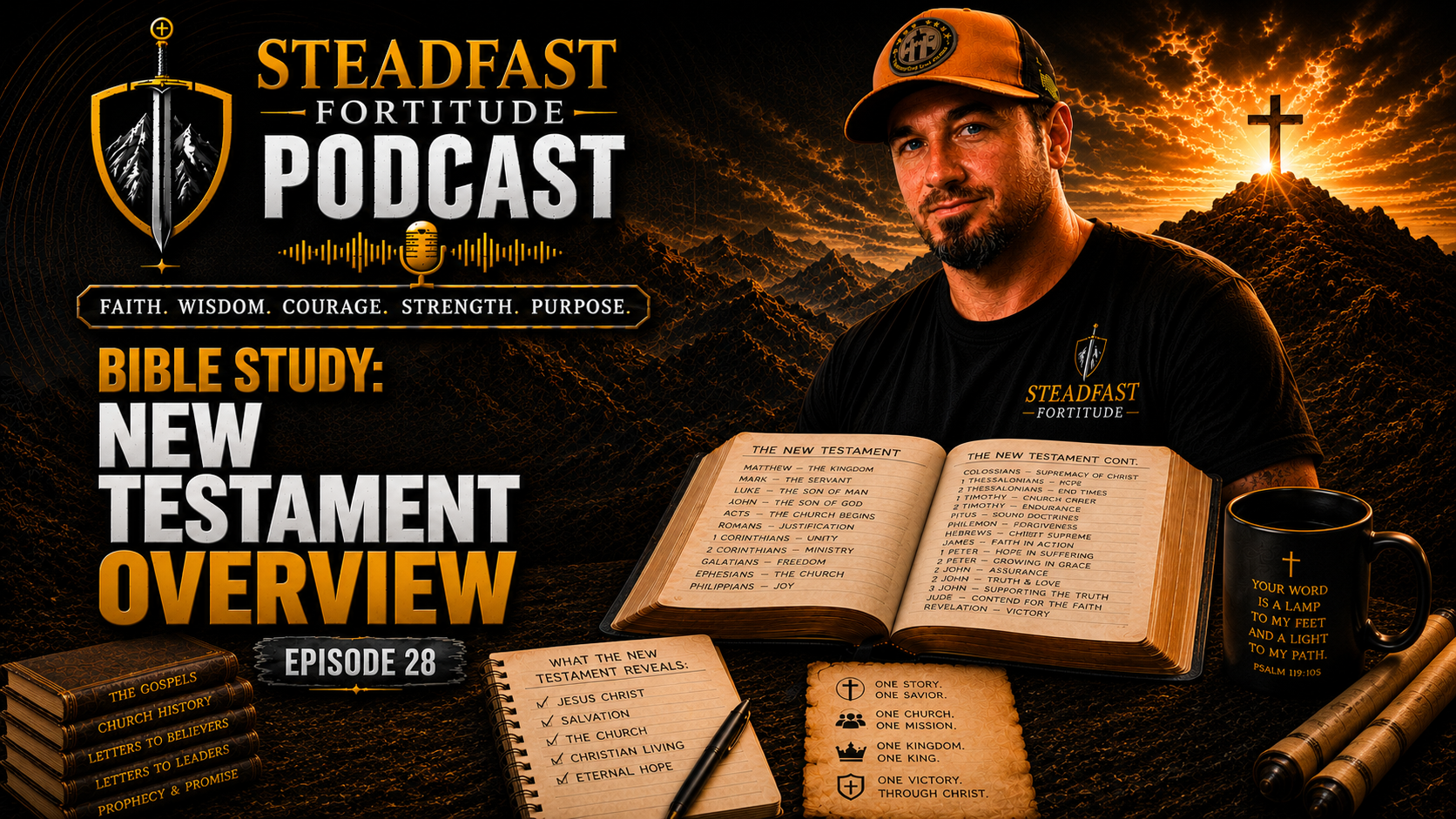
Episode 28: Bible Study – New Testament Overview
Episode Overview
How do the 27 books of the New Testament fit together, and what do they teach us about Jesus Christ? Episode 28 provides a bird’s-eye view of the New Testament, exploring the Gospels, Acts, the Epistles, and Revelation. This episode shows how each section contributes to one unified story centered on Jesus—revealing His life and ministry, the birth and growth of the Church, how believers are called to live, and the ultimate hope we have in Christ’s return and eternal kingdom.
Listen above, share this episode with someone who may need to hear its message, and follow the Steadfast Fortitude Podcast on your favorite podcast platform so you don’t miss future episodes.
Episode Context
If the Old Testament reveals God’s promises and prepares the way for the Messiah, the New Testament reveals how those promises find their fulfillment in Jesus Christ.
Its 27 books were written by multiple authors over several decades, but together they communicate one unified message. John 20:31 captures its purpose: “But these are written that you may believe that Jesus is the Messiah, the Son of God, and that by believing you may have life in his name.” (NIV)
The New Testament isn’t simply intended to provide historical or theological information. It reveals Jesus and calls us to place our faith in Him and faithfully follow Him.
The New Testament begins with the four Gospels—Matthew, Mark, Luke, and John. Each records the life, ministry, death, and resurrection of Jesus from a distinct perspective. Matthew emphasizes Jesus as the promised Messiah and King. Mark highlights the servant nature of Christ and His sacrificial mission. Luke emphasizes His compassion and carefully documents His ministry, while John focuses strongly on Jesus’ divine identity as the eternal Son of God.
Together, the Gospels answer the foundational question: Who is Jesus?
Next comes Acts, which records what happened after Christ’s resurrection and ascension. The Holy Spirit comes at Pentecost, the Church is established, the gospel is boldly proclaimed, and believers carry the message of Christ beyond Jerusalem. Through the ministries of Peter, Paul, and others, the gospel spreads across cultural and geographical boundaries.
Acts demonstrates that the good news of Jesus is intended for the entire world.
The Epistles, or letters, then explain how believers should live because of what Christ accomplished. Paul’s letters and the other New Testament writings address theology alongside practical issues facing real Christians and churches. They teach about salvation, grace, faith, Christian identity, relationships, spiritual maturity, suffering, obedience, unity, holiness, and perseverance.
If the Gospels show us what Jesus accomplished, the Epistles help answer another important question: How should we live because of it?
Finally, the New Testament concludes with Revelation. Its symbolism and imagery can sometimes seem intimidating, but its central message provides tremendous hope: Jesus Christ is victorious.
Evil doesn’t have the final word. Christ will return, sin and death will ultimately be defeated, God’s justice will prevail, creation will be made new, and His people will dwell with Him forever.
When we step back, the structure becomes beautifully clear.
The Gospels reveal Christ. Acts proclaims Christ. The Epistles explain life in Christ. Revelation reveals the ultimate victory of Christ.
The New Testament also helps us understand how the Old Testament finds fulfillment in Jesus. The sacrificial system anticipates the Lamb of God. The priesthood prepares us to understand Christ as our Great High Priest. God’s kingdom promises ultimately point toward Jesus as the eternal King.
As Second Corinthians 1:20 says, “For no matter how many promises God has made, they are ‘Yes’ in Christ.” (NIV)
Rather than approaching the New Testament as 27 disconnected books, we can read it as one unfolding story centered upon Jesus and God’s work of redemption through Him.
As you read, consider asking three questions:
What does this teach me about Jesus? What does it teach me about following Him? How can I apply this truth to my life today?
Stay rooted in God’s Word. Stand firm in your faith. Live with steadfast fortitude.