
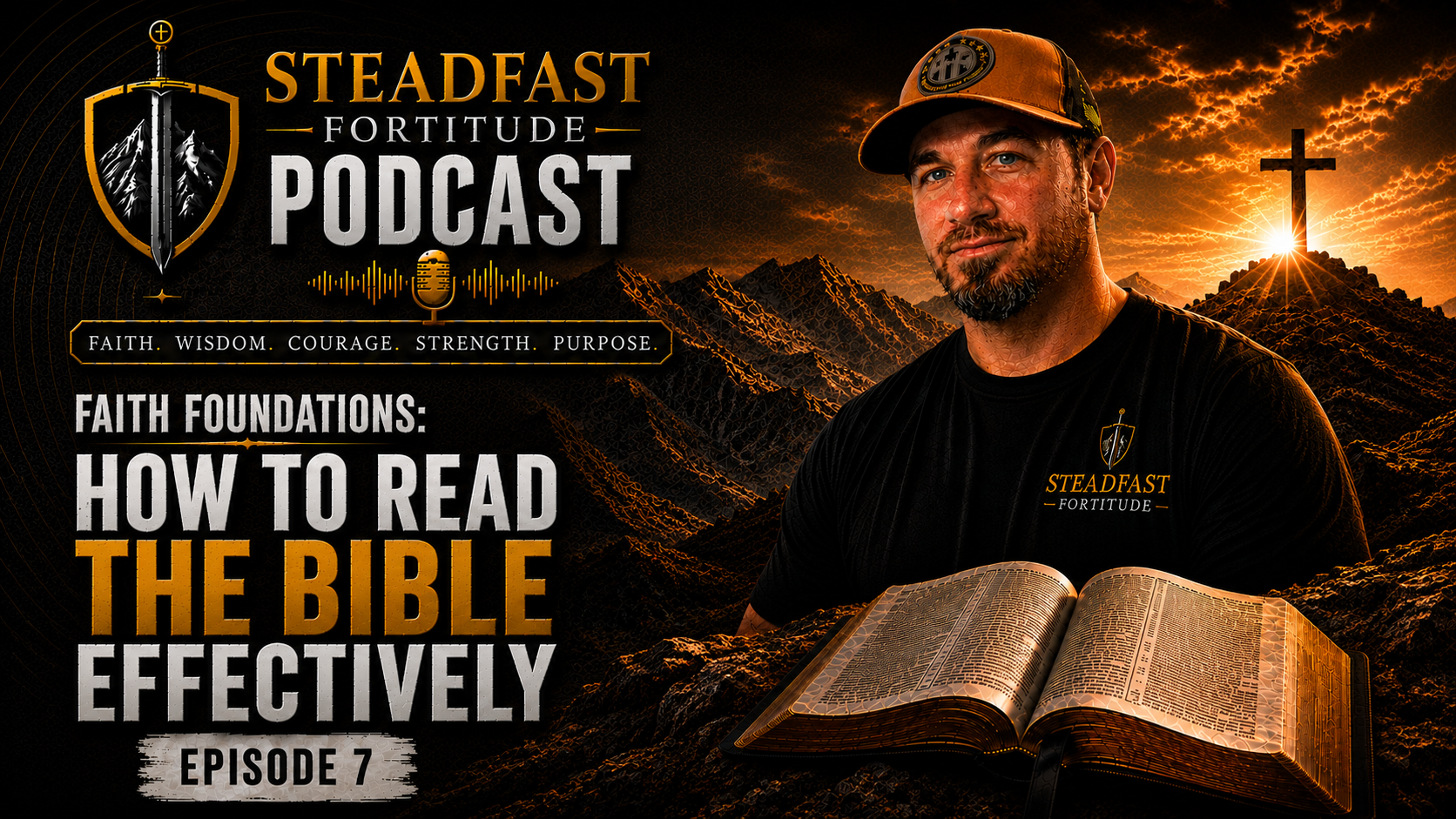
Episode 7: Faith Foundations – How to Read the Bible Effectively
Episode Overview
How can we move beyond simply reading the Bible to truly understanding and applying what God is teaching us? In Episode 7, we explore practical ways to read Scripture more effectively and intentionally. This episode looks at the importance of prayer, understanding biblical context, reading passages rather than isolated verses, asking meaningful questions, slowing down, and developing a consistent rhythm that helps God’s Word shape our everyday lives.
Listen above, share this episode with someone who may need to hear its message, and follow the Steadfast Fortitude Podcast on your favorite podcast platform so you don’t miss future episodes.
Episode Context
Many Christians have experienced the frustration of opening the Bible, reading several chapters, and realizing shortly afterward that very little of what they read actually stayed with them. With 66 books written by different authors across different periods of history and containing multiple literary styles, Scripture can sometimes feel overwhelming.
But God didn’t give us His Word to frustrate us. He gave it to teach, guide, correct, equip, and transform us.
Second Timothy 3:16–17 tells us, “All Scripture is God-breathed and is useful for teaching, rebuking, correcting and training in righteousness.” (NIV) Scripture is more than an ancient collection of religious writings. It is God’s inspired Word and one of the primary ways He shapes our understanding of truth and teaches us how to live faithfully.
Reading the Bible effectively begins with prayer. Before opening Scripture, we can simply ask God for wisdom and understanding. Rather than approaching the Bible merely to complete another daily task, prayer prepares our hearts to hear what God wants to teach us.
Effective Bible reading also requires understanding context. Before immediately asking, “What does this verse mean for me?” we should first ask what the passage meant to its original audience. Who wrote it? Who were they writing to? What was happening at the time? What is being discussed in the surrounding verses?
This is why reading complete passages instead of isolated verses is so important. Individual verses can easily be misunderstood when separated from the larger message in which they appear.
We can also become more intentional readers by asking simple questions: What does this teach me about God? What does it reveal about humanity? Is there a command to obey, a warning to consider, an example to follow, or a promise to trust?
These questions move us from passive reading toward genuine engagement with God’s Word.
Sometimes effective Bible reading also means simply slowing down. Scripture isn’t a race, and spiritual growth isn’t measured by how many chapters we finish. One chapter carefully read and understood can be far more valuable than several chapters rushed through without reflection.
Psalm 119:105 says, “Your word is a lamp for my feet, a light on my path.” (NIV) A lamp doesn’t necessarily reveal the entire journey ahead. It provides enough light to take the next step. God’s Word often works similarly, giving us the wisdom and truth we need to faithfully walk the path before us.
Consistency therefore matters more than quantity. Developing a sustainable daily rhythm allows Scripture to gradually shape our thoughts, decisions, priorities, and character.
Ultimately, however, the goal isn’t simply to know more about the Bible. The goal is to know God more deeply. From Genesis through Revelation, Scripture reveals God’s character and unfolds His plan of redemption through Jesus Christ.
As you reflect on this episode, consider this question:
Am I simply reading God’s Word—or am I allowing God’s Word to shape the way I live?
Stay rooted in God’s Word. Stand firm in your faith. Live with steadfast fortitude.